
What is the significance of sociological research in Marketing game?
That is also why the question “What is the significance of sociological research in Marketing game?” is gaining increasing attention. Sociological research helps brands view players from a broader perspective than standard demographic data. Instead of merely knowing a player’s age, location, or device, companies can understand why they play, who influences them, how they interact with the community, and what factors keep them engaged with a game.
In this article⌄
Marketing game today is no longer simply about exposing a game to as many people as possible. With a market saturated with competing products, players having more choices, and online communities increasingly influencing their decisions, understanding players has become a crucial foundation for developing an effective strategy.
That is also why the question “What is the significance of sociological research in Marketing game?” is gaining increasing attention. Sociological research helps brands view players from a broader perspective than standard demographic data. Instead of merely knowing a player’s age, location, or device, companies can understand why they play, who influences them, how they interact with the community, and what factors keep them engaged with a game.
According to Gamota’s Vietnam Mobile Gaming Year-in-Review 2025, Vietnam has approximately 54 million mobile gamers, while the market’s revenue in 2025 reached about 825 million USD, an increase of 9.16% compared to the previous year. However, only about 7–10% of mobile gamers actually spend money on games. This disparity highlights that a large-scale market still comprises many player groups with vastly different behaviors and needs.
Therefore, rather than simply asking, “How many players are there?”, marketing needs to delve deeper into the questions: “Who are they, why do they play, and what makes them choose to stay engaged with the game?”
Sociological research helps game marketers understand players
Players are defined by more than just age and gender
In marketing, demographic data is often used to identify target customers. For games, information such as age, gender, geographic location, devices used, and purchasing power remains essential. However, this data only tells us who the players are; it does not explain why they act the way they do.
Two people of the same age, who both use their phones to play games and share an interest in the same genre, may still have completely different motivations. One might play for entertainment after work, another might seek a sense of competition, while yet another might participate simply because their friends are playing.
This is also a key focus for ANBU when conducting player research: rather than merely collecting information about the subject, we need to create opportunities for players to recount their own experiences. Seemingly mundane answers—such as when they play, who they usually play with, what keeps them coming back to the game, or what frustrates them—can reveal needs that demographic data fails to capture.
Sociological research thus helps place players within their living environments and social relationships. Players may be influenced by friends, online communities, content creators, cultural trends, or norms established within the very groups they belong to.
As a result, a player’s profile is no longer just a collection of basic information but has become a clearer picture of their needs, behaviors, and social relationships.
The motivation to play games doesn’t come solely from gameplay
Gameplay is a key element of the experience, but it isn’t always the only reason players start or continue playing.
In games with multiplayer elements, the social experience can become an integral part of the product. Players can find friends, form teams, join guilds, chat, or complete quests together. Over time, the relationships formed within the game can become the reason they return.
A study on online gaming communities in 2026, based on data from 1,202 players, found that cooperative knowledge and adherence to community norms were linked to community-supportive behavior and the frequency of game play.
From a practical research perspective, this also highlights a noteworthy issue: players sometimes find it difficult to accurately articulate why they continue playing. They might say that “the game is fun,” but when asked more deeply, the real reasons often lie in having friends in the game, being accustomed to the community, or not wanting to abandon the progress they’ve made.
This is precisely why in-depth interviews are valuable in Marketing game research. A superficial answer can lead to a completely different insight when placed in the right context.
How does the community influence player behavior?
When joining a gaming community, players don’t just receive information from the publisher. They also receive feedback from other players, creators, streamers, and influential members of the community.
These conversations can shape players’ perceptions of the game. A game that receives positive reviews from the community may inspire more trust, while widely circulated negative issues can influence the decision to download or continue playing.
A study on the online gaming community in Vietnam also showed that perceptions of the virtual community and community identity are linked to players’ intentions to purchase in-game products.
At ANBU, this is why player research shouldn’t stop at simply asking, “Do you like the game?” It’s important to also observe what players say to each other, the language they use when discussing the game, and the topics that consistently come up in their conversations. These details can help brands understand the community’s true sentiments.
Sociological research helps uncover player insights
Identifying the needs and motivations behind gaming behavior
One of the most important values of sociological research is that it helps marketing move from observing behavior to understanding the causes of that behavior.
For example, data might show that players frequently watch gaming videos on TikTok. But this metric alone cannot explain why they watch. They might be looking for tutorials, watching highlights, following streamers, seeking reviews before downloading a game, or simply watching for entertainment.
Without digging deeper, marketers can easily jump to the general conclusion that “gamers like TikTok” and, as a result, produce content in a one-size-fits-all manner.
When researching players, ANBU can approach the issue from the opposite direction: starting with observed behavior, then exploring the context and motivations behind it. When players recount their experiences in their own words, unspoken needs often become clearer.
This forms the basis for transforming research data into actionable insights for marketing.
Understanding the role of friends and community in gaming decisions
The decision to download a game sometimes begins with an invitation from a friend, a conversation within a community, or a shared video.
Especially in multiplayer games, having friends already in the game can lower the barrier to entry. Players don’t have to figure everything out on their own; they can receive guidance and support from those who have played before.
This makes social influence a key factor worth studying in Marketing game.
Instead of simply asking, “Do players like the game?”, research can delve deeper into questions like “Who introduced them to the game?”, “Whose advice do they usually seek?” and “What aspects of the community led them to decide to join?”
Based on experience conducting player research, such open-ended questions are often more valuable than simply asking participants to select a predefined answer. They provide an opportunity for players to share the stories and reasons behind their decisions.
How do creators influence gamers?
Creators and streamers are increasingly serving as a bridge between games and the community. They not only introduce products but also offer their own interpretations of games through their personal experiences.
A 2026 study on gaming content creators in Thailand surveyed 400 followers across online platforms. The results showed that digital content strategy, influencer authenticity, and the customer journey all had a significant relationship with audience engagement; in the research model, the customer journey had a strong influence on engagement.
Therefore, when implementing influencer marketing, brands should not focus solely on the number of followers. More importantly, they should assess whether the creator is genuinely trusted by the target community and has the ability to spark conversations about the game.
Sociological research helps answer this question by examining the relationship between the creator and the community, rather than viewing the creator merely as an advertising channel.
Why do gamers share gaming content?
Not all content with high view counts gets shared. Gamers typically share content that makes them feel a personal connection or a sense of belonging to their community.
A video might be shared because it’s funny, a moment might be shared because it’s so impressive, and a post might go viral because it addresses an issue many gamers are facing. Therefore, marketers need to understand the social motivations behind sharing behavior.
By recognizing that players share to showcase their skills, seek empathy, connect with friends, or demonstrate their sense of belonging to a community, brands can create more relevant content rather than simply focusing on increasing view counts.
Applications of sociological research in each stage of Marketing game
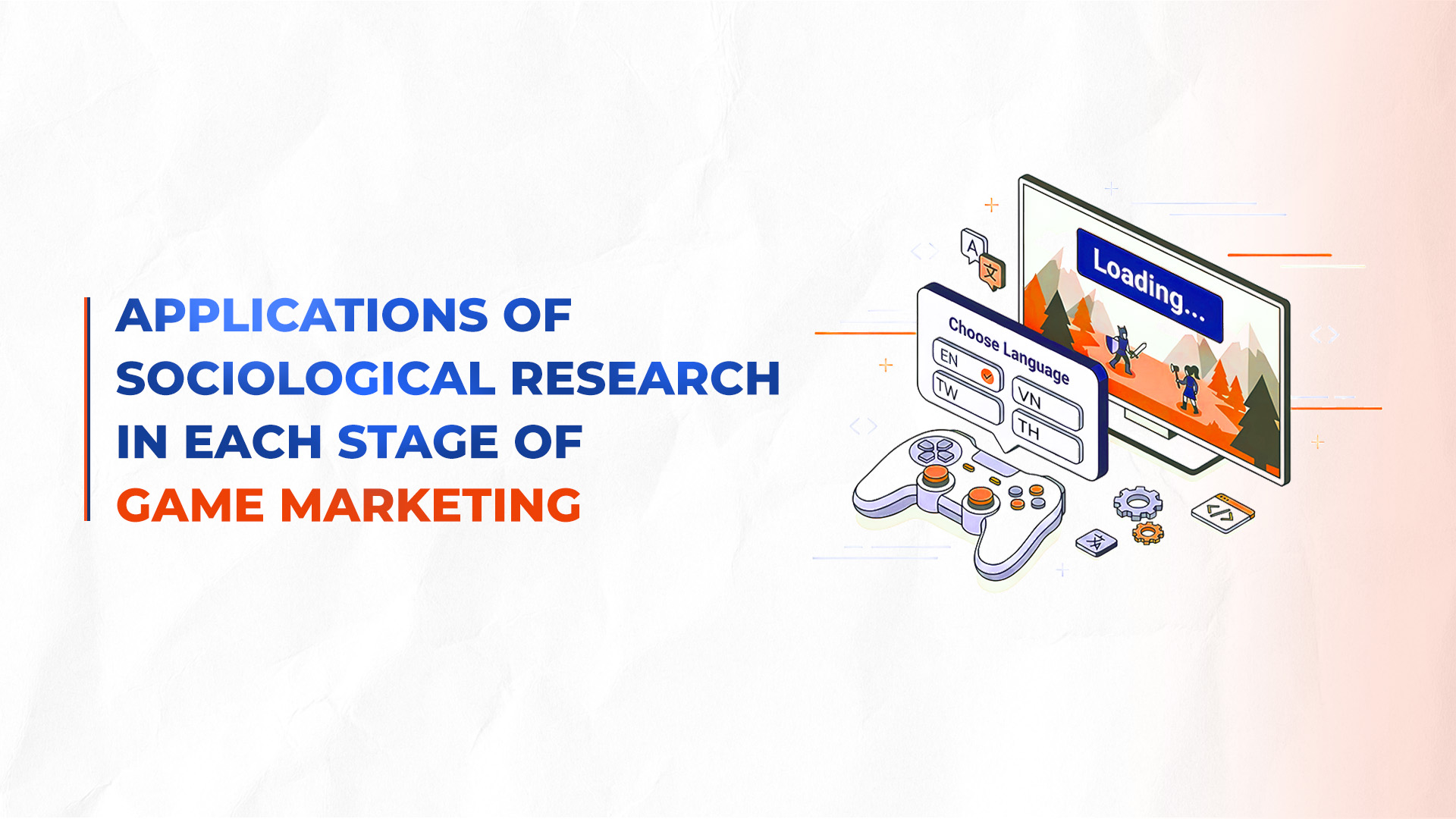
Pre-launch: Market research and target players
Sociological research can begin before the game’s official release. This is when the brand needs to understand the market, identify the appropriate player base, and uncover unmet needs.
In-depth interviews can help uncover players’ motivations and expectations. Surveys help validate trends on a broader scale. Focus groups help observe how players interact with one another, while social listening allows the brand to track topics of interest within the community.
In practice, ANBU can combine multiple data sources rather than relying on a single method. What players say in interviews, what the community is discussing on social media, and what behavioral data reveals can all complement one another. When these data sources all point to the same issue, the insights will have a more solid foundation.
Combining these methods allows marketers to avoid guessing what players want and instead build strategies based on concrete evidence.
At launch: monitor the community’s reaction
When a game is released, player behavior and reactions can change very quickly. What the brand predicted before launch may not necessarily match the actual reaction.
Marketing teams need to observe the community to understand what players are saying, which features are popular, what issues are causing frustration, and which topics are being discussed most frequently.
However, a few prominent comments should not be taken as representative of the entire player base. An issue is only truly significant when it is verified across multiple data sources.
In game experience studies, listening to players must also be conducted systematically. Rather than simply recording “like” or “dislike” responses, it’s important to examine which elements players are reacting to, in what contexts, and why they feel that way.
This is where qualitative and quantitative research must be used in tandem to distinguish between individual opinions and general trends.
Post-Launch: Identifying the reasons for player retention and churn
After launch, the more critical challenge is retaining players. If one group of players remains active in the community while another gradually leaves, the marketing team needs to investigate the underlying causes.
Perhaps they can’t find suitable teammates, don’t feel welcomed by the community, or no longer see a reason to return to the game.
Community research can help uncover issues that behavioral data alone struggles to explain. Instead of merely noting a decline in player numbers, the marketing team can investigate why players are leaving. This is a crucial distinction between measuring results and understanding behavior.
Combining quantitative and qualitative data to make decisions
Quantitative data helps marketers understand what is happening. Qualitative research helps explain why it is happening.
For example, a decline in engagement rates for a piece of content can be identified very quickly using data. But to understand the cause, marketers may need to read comments, interview players, or observe how the community reacts to that content.
In real-world research, ANBU might use quantitative data as a starting point to identify a problem, then use interviews or qualitative research to dig deeper into the causes. Conversely, insights gained from interviews also need to be validated by data on a broader scale.
When these two data sources are combined, the brand can make decisions based on both numbers and context.
From Player Insights to Effective Marketing game Strategies

Turning insights into marketing messages and content
Insights are only valuable when they are turned into action. If research shows that players care about the experience of playing with friends, marketing content can focus on group-play moments. If players trust content creators, the brand can prioritize real-life experience content rather than relying solely on advertising messages.
From ANBU’s perspective, the key is not to generate as many insights as possible, but to identify which insights have the potential to actually influence marketing decisions.
A good research finding should answer the question: “How does this discovery change the way the brand communicates with players?”
If the answer isn’t clear, the research hasn’t truly fulfilled its purpose.
Building a community based on players’ real needs
A gaming community cannot grow sustainably if it relies solely on announcements from the publisher.
Players need a reason to come back, chat, and interact with one another. It could be a place to find teammates, share gameplay tips, discuss updates, or simply talk together about exciting moments in the game.
Sociological research helps brands identify what the community needs, allowing them to choose the most appropriate approach.
This is also one of the areas where ANBU can serve as a bridge between research and marketing. Rather than merely drawing conclusions about players, research findings should be translated into specific guidelines for content, community management, and how the brand interacts with players.
Measuring effectiveness isn’t just about views and downloads
A campaign with millions of views doesn’t necessarily build a strong player community.
Marketing game needs to assess effectiveness across the entire journey—from awareness, game downloads, and engagement to community participation, retention, and referrals.
More importantly, these metrics need to be considered alongside player research. A declining retention rate isn’t just a number that needs improvement—it’s a signal for the marketing team to investigate the underlying causes.
When data and research are combined, the brand can understand what’s happening, why it’s happening, and what changes need to be made.
Understanding players to build long-term value for games
Games can attract players through advertising, but keeping them engaged requires more than that. A 2025 study of 427 MMOG players in Vietnam found that perceptions of the virtual community and community identification are linked to the intention to purchase non-functional in-game items. These results suggest that a sense of belonging to a community can be linked to players’ commercial behavior.
Ultimately, the answer to the question “What is the significance of sociological research in Marketing game?” lies in the ability to understand the people behind the numbers. Data can reveal how many downloads, how many players, or how many interactions there are. Sociological research helps marketers understand what drives players to choose, share, engage, and stay.
Ultimately, the answer to the question “What is the significance of sociological research in game marketing?” lies in the ability to understand the people behind the numbers. Data can reveal how many downloads, how many players, or how many interactions there are. Sociological research helps marketers understand what drives players to choose, share, engage, and stay.
As the gaming market becomes increasingly competitive, the competitive edge lies not only in advertising budgets or the ability to create eye-catching content. A sustainable strategy must begin with a true understanding of the players and the social environment in which they live.
ANBU combines player research, market analysis, and real-world implementation experience to help publishers better understand their players. From insights to strategy, ANBU partners with brands to develop approaches tailored to each market and gaming community. Contact ANBU to get started on player research for your game.
💬 Reader Discussion
Share your perspective, questions, or campaign experience.
Đang tải bình luận...